


Why Development Approvals Are Critical
Many development projects require formal approvals beyond building permits. Land division, zoning amendments, and official plan amendments all require specific approvals through municipal committees and councils. These approvals establish legal authority to proceed with development that doesn't conform to current regulations.
Without proper approvals, development cannot legally proceed, properties cannot be sold or financed, municipal enforcement can order cessation and removal, and projects face delays and potential legal challenges.
After 25+ years presenting to Committees of Adjustment and municipal councils across Ontario, we understand what can be supported and what can't. This experience translates directly into higher approval rates and shorter timelines for our clients.
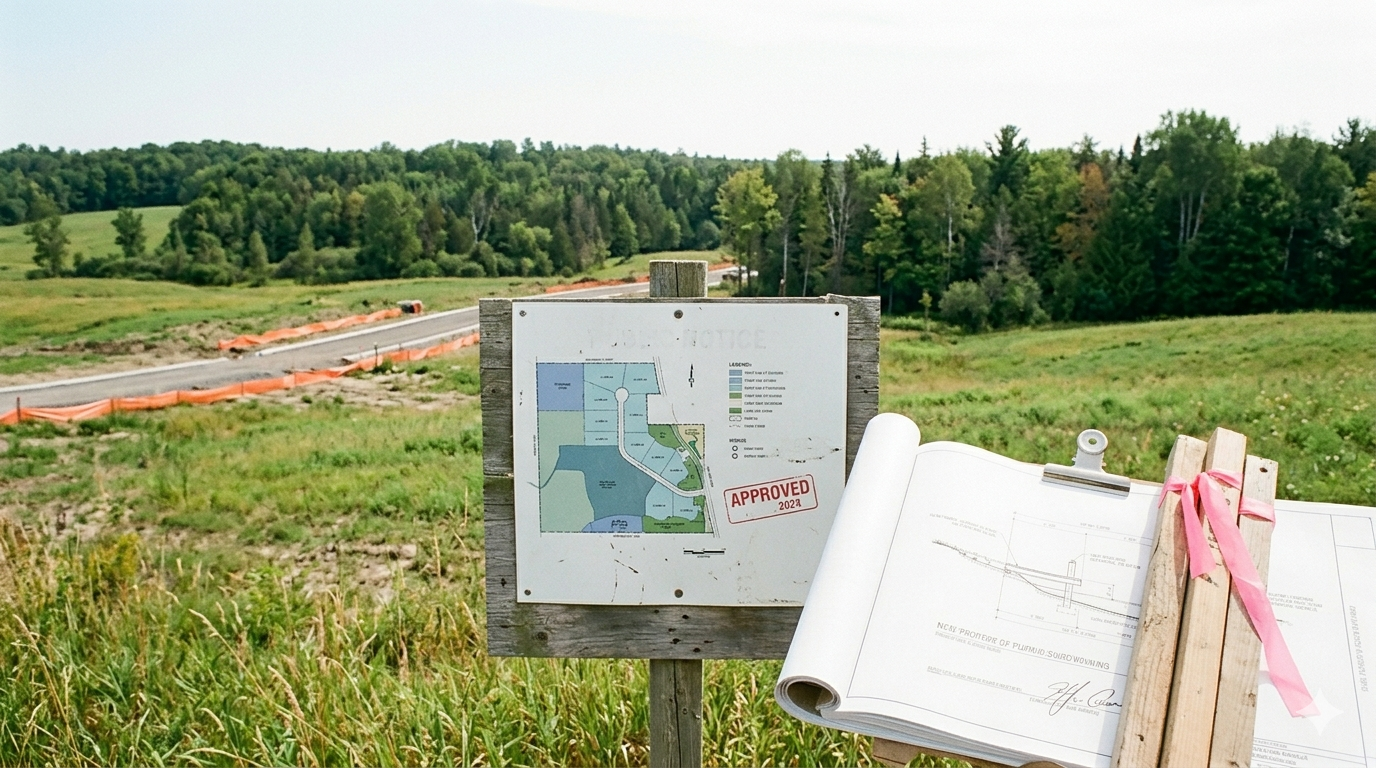
Approvals We Secure
Severance / Consent Approvals
ALot creation, lot additions, lot line adjustments, easements and correction of title require consent approval through your municipal Committee of Adjustment. While often considered simpler than subdivision approval, consent applications demand careful attention to planning policy compliance, technical requirements, and condition fulfillment.
We assess severance feasibility under current planning policies, prepare complete consent applications with all supporting documentation, coordinate required studies including environmental assessments and surveys, present applications to Committee of Adjustment, respond to agency comments and concerns, and fulfill all approval conditions including reference plan preparation, easement registration, and agreement execution.
We've successfully presented hundreds of consent applications to Committees across Kawartha Lakes, Peterborough, and Durham Region. Typical timeline from application to condition clearance runs three to six months depending on municipal processing speed and application complexity.
Minor Variance
Minor variance applications allow small modifications to zoning by-law requirements including but not limited to setbacks, lot coverage, height limits, and parking standards through Committee of Adjustment. All variance applications must satisfy four statutory tests: the variance must be minor in nature, represent desirable development for the area, maintain the general intent of the zoning bylaw provision, and align with the general intent of the Official Plan.
We analyze variance eligibility under these four tests, prepare variance applications with comprehensive planning rationale, conduct neighbour consultation where strategically beneficial, present applications to Committee and respond to questions, and address any objections or concerns raised during the process.
Our understanding of the four variance tests comes from extensive Committee presentation experience across the province. Typical timeline runs two to four months from application to final decision.
Zoning By-Law Amendments
When proposed development requires changes to permitted uses, density limits, or other fundamental zoning provisions, rezoning through municipal council becomes necessary. This process involves more extensive analysis, public consultation, and council approval compared to variance applications.
We assess rezoning requirements and demonstrate policy compliance through detailed planning justification reports. Pre-consultation with planning staff identifies concerns and expectations before formal submission. We manage the complete public consultation process, present applications to planning committees and council, address public and agency comments constructively, and navigate the approval process through final council decision.
As PKHBA members actively engaged in municipal planning discussions, we stay current with official plan policies and planning priorities affecting approval decisions. Typical timeline ranges from six to twelve months depending on municipal procedures and application complexity.
Official Plan Amendments
Official Plan amendments change fundamental municipal policies to permit development not contemplated under current planning frameworks. These amendments are required before zoning changes when the Official Plan doesn't support proposed development.
We prepare comprehensive planning studies and policy justification demonstrating consistency with provincial policies and municipal objectives. All required background studies are coordinated including market analysis, environmental assessments, and infrastructure capacity studies. We manage extensive public consultation processes and present to planning committees, council, and potentially provincial review bodies.
Official Plan amendment experience provides insight into policy frameworks, approval likelihood, and effective strategies for achieving positive decisions. Typical timelines range from eight to sixteen months varying by municipality and provincial approvals.
Site Plan Approval
Site plan control is a technically detailed transition between the planning and construction phases. We manage the approval process for the arrangement of buildings, parking, landscaping, and services on a specific property to ensure functional and aesthetic compatibility with the surrounding community.
Our team coordinates the submission of detailed site drawings, liaises with municipal planning and engineering departments, and addresses technical comments to secure the necessary agreements required for building permit issuance.
Resolving Zoning Violations
Understanding Violations
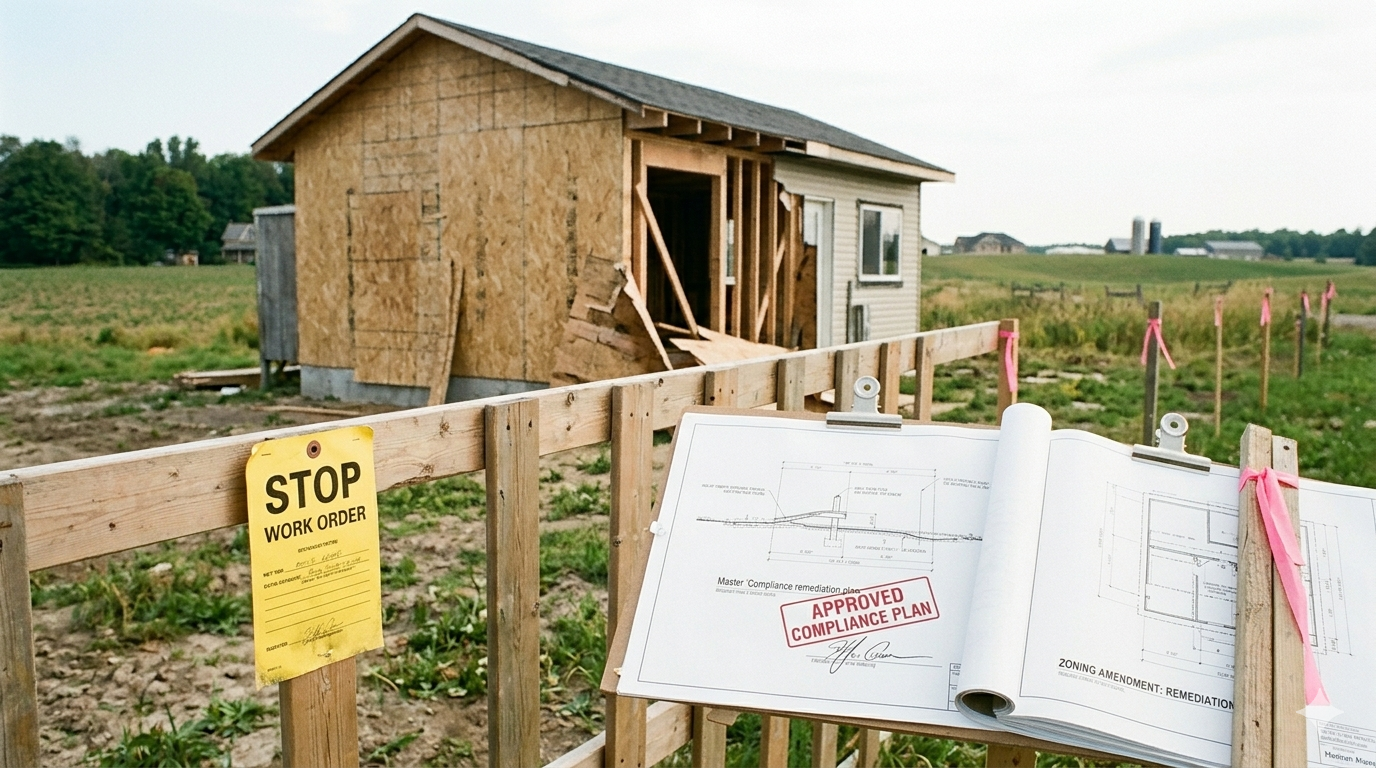
Municipal enforcement actions arise when development proceeds without required approvals or permits, or violates zoning regulations. Common violations include construction without building permits, setback viloations, uses not permitted by zoning, and unpermitted demolitions.
We've helped dozens of property owners resolve violations through strategic compliance solutions rather than costly removal. Our professional relationships with municipal enforcement officers facilitate productive resolution discussions rather than adversarial proceedings.
How We Help
We assess the specific violation and compliance options, determine the most cost-effective resolution, liaise professionally with enforcement officers to negotiate reasonable compliance timelines, apply for necessary permits, variances, zoning amendments, coordinate required remediation work, and obtain final compliance sign-off from the municipality.
Early professional intervention prevents escalation from warnings litigation to prosecution. What might seem like an impossible situation often has practical solutions when addressed strategically with experienced guidance.
Here are some frequently asked questions
Expert answers to common development approval questions from our 25+ years serving multiple municipalities across Ontario, developers and landowners.
What permits do you handle?
Building permits, demolition permits, septic permits, conservation permits, Trent Severn Waterway permits, MTO permits, DFO permits, and MNRF permits.
What services do you offer for residential developments?
We provide comprehensive development consulting including subdivision approvals, site plan design, permits, conservation authority coordination, zoning amendments, minor variances, and full project management. From single-lot development to multi-phase subdivisions, we handle all approval requirements.
Do you work with conservation authorities?
Yes, we regularly coordinate with Kawartha Conservation, Trent Conservation, Lake Simcoe Region Conservation Authority, and other conservation authorities across Ontario. We prepare required permits for development in regulated areas including floodplains, wetlands, and shorelines.
What if my property has zoning issues?
We handle zoning amendments and minor variance applications regularly. Many developments require zoning changes, which we integrate into your overall approval strategy. We assess whether your situation qualifies for a variance or requires a full amendment.
What happens during the initial consultation?
We discuss your project objectives, review property constraints, assess development feasibility, identify required approvals, and outline the pathway forward. Initial consultations are free with no obligation, allowing you to understand the process before proceeding.